I borrow here from Toni Morrison’s Beloved because it is an excellent book and when I taught it, I used to emphasise enormously the importance of names. How a collection of letters can comprise our identity, they are our first signifiers. And yet, how contested.
The woman I am looking for, who will not be found, is Christina Collins. Like me. Murdered in 1839, she was a month off her 38th birthday. And she had not been Christina Collins for long.
Born as Christina Brown on 17th July, 1801, according to the St Mary, Nottingham parish records, she was – allegedly – Christina Ingleby for most of her adult life. Except, as noted in my earlier post, I cannot find a marriage certificate. She married again to the man who testified at her murder trial as her husband, Robert Collins, but I can also find no marriage certificate between a Christina Ingleby and Robert Collins.
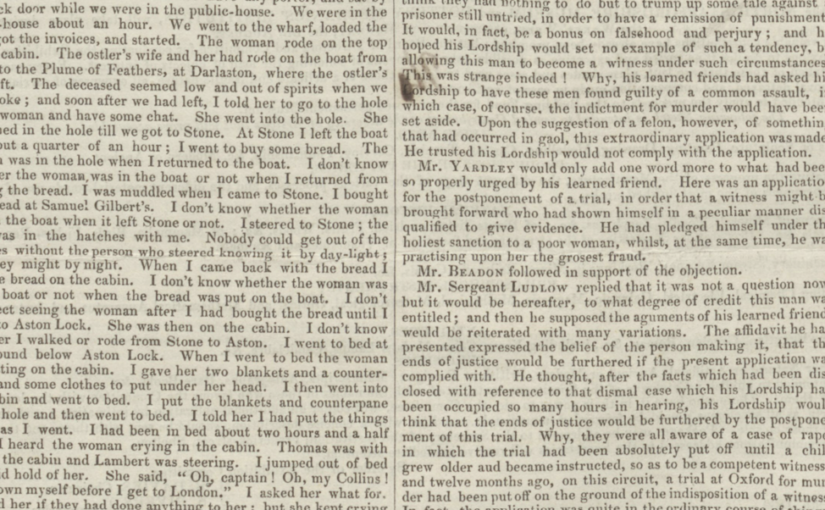
From newspaper reports of the trial and execution of Christina’s rapists and murderers, we know plenty about the death of the thirty-seven-year-old woman in the fawn kerchief and blue bonnet. But the links between that and a baby born in Nottingham to Robert Brown and Christiana Jones (a month after their marriage?) are tenuous. In records, I’ve not found anything between newspaper records of her murder, and this parish birth certificate. There is a thirty-seven-year gap in the middle.
And so I was thinking about names. The shakiness of them. I – of dubious fame for never changing my name at traditional life points – was actually born as Christina Lowrie. I never tell people that; or speak that name aloud. That is the first time I have ever written that sentence. It feels strange looking at that construction – it somehow reproaches me with this alternate identity. But there is no document formalising my common-usage change to Collins as a child. There are various qualification certificates – Christina Collins BA, Christina Collins MA (with distinction – just in case I hadn’t mentioned that this week), my bank account; my work profile, there is also a certificate of a Christina Collins marrying. But nothing links it to that birth. Now, I write as C. E. Collins. If a future Christina Collins tried to find me, what would she find of my life? A woman who burst into life birthless and fully formed like goddamn Athena, collecting her degree? Am I equally invisible?
There are such difficulties in discovering this undocumented Christina. Goodness, what must it be like for people trying to trace refugee ancestors. Everything I have decided about Christina is speculation. I have written about her making lace because her father made lace machines; because she worked as a dress maker. But did she make lace? Did she like to read? Did she recite poems? This impossibility of knowing her. And somehow, in this trail of names, the impossibility of being known, myself.
It is absurd to me that the murderers who actively used aliases (to avoid being pinned down for their continuous criminality) are still more easily traceable. Women change their names when they marry, identity destabilises; there is a break in the links of their life. If you are a man, reading this, your name most likely will never have changed. I am thinking of you now, how you sit in the stability of your unassailable Name. If you’re a woman, however, you may already be on a second. Tell me; if you’re in a partnership but you retained your own Name – how did that conversation go for you? What endless explanations and defences you are forced to make? The assumptions you must correct? But listen – just like us, these men did change their names. And yet we can still find them. Each of them. Thomas alias Dobell. Ellis alias Lambert. Why am I not Collins, alias [other]? It frustrates me still that even I could not remain in the stability of a single, irreproachable name. That I could also be lost in the history of fragmentations.
How to leave some trace. To state, be witnessed, I was here.