
Who does the naming?

I borrow here from Toni Morrison’s Beloved because it is an excellent book and when I taught it, I used to emphasise enormously the importance of names. How a collection of letters can comprise our identity, they are our first signifiers. And yet, how contested.

The woman I am looking for, who will not be found, is Christina Collins. Like me. Murdered in 1839, she was a month off her 38th birthday. And she had not been Christina Collins for long.

Born as Christina Brown on 17th July, 1801, according to the St Mary, Nottingham parish records, she was – allegedly – Christina Ingleby for most of her adult life. Except, as noted in my earlier post, I cannot find a marriage certificate. She married again to the man who testified at her murder trial as her husband, Robert Collins, but I can also find no marriage certificate between a Christina Ingleby and Robert Collins.

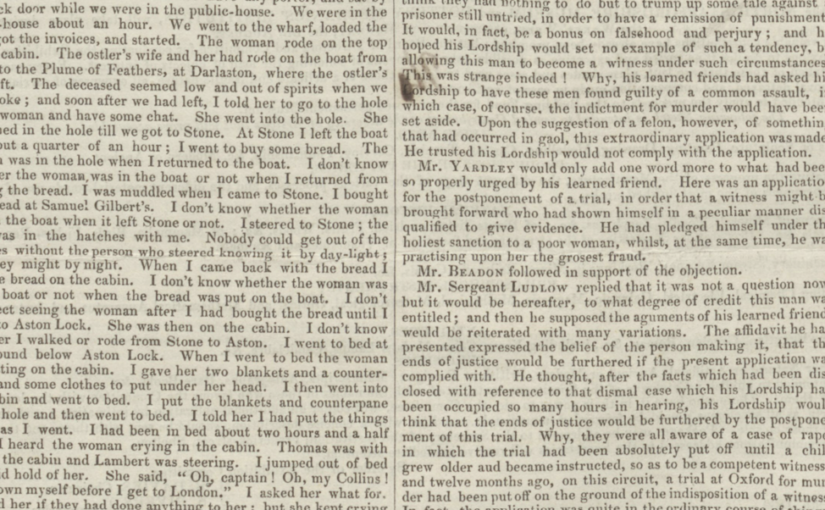
From newspaper reports of the trial and execution of Christina’s rapists and murderers, we know plenty about the death of the thirty-seven-year-old woman in the fawn kerchief and blue bonnet. But the links between that and a baby born in Nottingham to Robert Brown and Christiana Jones (a month after their marriage?) are tenuous. In records, I’ve not found anything between newspaper records of her murder, and this parish birth certificate. There is a thirty-seven-year gap in the middle.

And so I was thinking about names. The shakiness of them. I – of dubious fame for never changing my name at traditional life points – was actually born as Christina Lowrie. I never tell people that; or speak that name aloud. That is the first time I have ever written that sentence. It feels strange looking at that construction – it somehow reproaches me with this alternate identity. But there is no document formalising my common-usage change to Collins as a child. There are various qualification certificates – Christina Collins BA, Christina Collins MA (with distinction – just in case I hadn’t mentioned that this week), my bank account; my work profile, there is also a certificate of a Christina Collins marrying. But nothing links it to that birth. Now, I write as C. E. Collins. If a future Christina Collins tried to find me, what would she find of my life? A woman who burst into life birthless and fully formed like goddamn Athena, collecting her degree? Am I equally invisible?

There are such difficulties in discovering this undocumented Christina. Goodness, what must it be like for people trying to trace refugee ancestors. Everything I have decided about Christina is speculation. I have written about her making lace because her father made lace machines; because she worked as a dress maker. But did she make lace? Did she like to read? Did she recite poems? This impossibility of knowing her. And somehow, in this trail of names, the impossibility of being known, myself.

It is absurd to me that the murderers who actively used aliases (to avoid being pinned down for their continuous criminality) are still more easily traceable. Women change their names when they marry, identity destabilises; there is a break in the links of their life. If you are a man, reading this, your name most likely will never have changed. I am thinking of you now, how you sit in the stability of your unassailable Name. If you’re a woman, however, you may already be on a second. Tell me; if you’re in a partnership but you retained your own Name – how did that conversation go for you? What endless explanations and defences you are forced to make? The assumptions you must correct? But listen – just like us, these men did change their names. And yet we can still find them. Each of them. Thomas alias Dobell. Ellis alias Lambert. Why am I not Collins, alias [other]? It frustrates me still that even I could not remain in the stability of a single, irreproachable name. That I could also be lost in the history of fragmentations.

How to leave some trace. To state, be witnessed, I was here.
Click bait

Another week of reading newspaper archives. Hats off to old Godwin – I have found in the Staffordshire Advertiser twice, and the Wolverhampton Chronicle once – the very words that he uses: the men approached the scaffold with firm step and needed no assistance.

Welcome back to: Chris Documents the Documents, as I read archival information about a dead woman with my name. Last week I was incandescent with rage because the main source text on this event seems to have deliberately altered reportage wording. This week, whoops, found it!

Interesting, though, innit. One local journalist refers to the convicts as too agitated to mount the scaffold, while another venerates their firm step. Which is true? Which was right? Godwin made his choice. That there, is another question to ask. Meanwhile, we see that reporting bias in linguistic choices (mark it, year 9) has always existed in journalism. The biases are signifiers of what a society regards as important, what matters, and what does not.

Which lives matter most.

All evening, I huddle in the kitchen in that warm glow the under-cupboard lights give. Its similarity to the dimness of candlelight does not escape me, but I am not always so fanciful; one can’t be in front of a laptop. I drink wine, grimly; I read and wince. Again, in the morning, while the juvenile sparrow that’s taken up a roving residence in my garden agitates the fuchsia, I drink half cups of tea and read. Working through every article on the subject from 1839 to 1840 in order and I still haven’t finished.

What I have noticed is that through spring 1840, Christina’s name all but disappears. She already flickers through the opaque shadows of these careless records; her evasive marriages and homes vanish out of site like someone who has just left the room. There remains a slight change in pressure as the air resettles with its adjusted mass, the only sign someone was there. And after all the accounts of the trial and onto the drama of the execution, she is no longer at the centre of her own story.

Instead, the convicted are centre stage. Who visited them in prison, who wept for them, their conduct, their friendships. This becomes the stuff of literature, the stuff of great themes, these three men languishing under the awful shadow of death which suddenly rarifies their existence. Can I please bring us back to Christina? In the dark of the cabin or the towpath, under the awful shadow of her abuse? Or does it disgust us so much, we would rather look away. These are not men made heroic by suffering. They were the kind of dickheads who hassle you, drunk, in a pub; that follow you home, humiliate you, and if mostly convinced they can get away with it, push you into a corner and put their hands on you. We have all had it. So can I take you back to that, despite the journalist from the Staffordshire advertiser throwing around dramatic statements like, ‘hope of rescue’ as if these men are unfortunates fetched up in some simple peril of a storm or rushing river. They were convicted murderers.

But the cynical approach of clickbait was urgent even then, and the last moment reprieve of one of the prisoners is repeated over and again. The ‘affecting scene’, the friendship and brotherhood, their weeping, their prayers. I blamed Godwin for his portrayal of this source. In fact, it was the papers of the day that really went to town on it; the same words were sold to the Wolverhampton Chronicle, then the Staffordshire Advertiser, on a slow day the following week, published the exact same article again. That drama, that invented narrative; that was left. Dostoyevsky talked about creating romances and stories out of things. This last memory of someone life was someone else’s joyful reprieve.

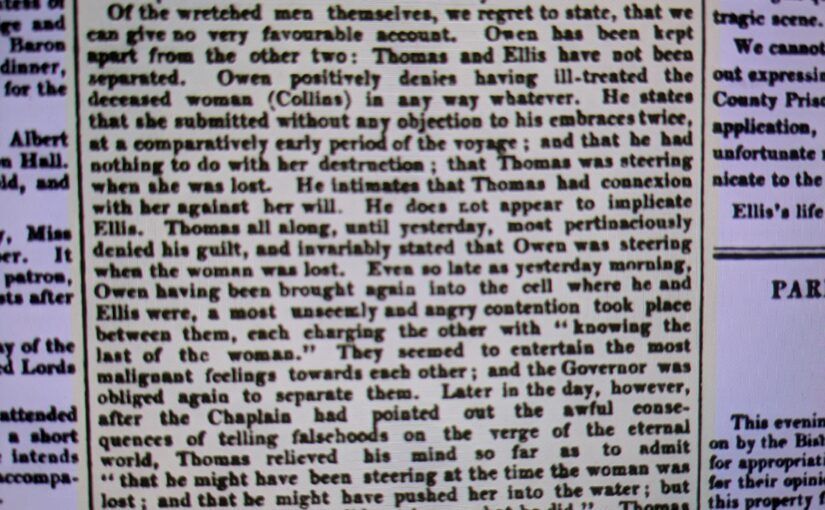
To be as fair as possible, I don’t believe in capital punishment, either. I don’t agree the men should have been hanged. Look what it makes of the thing! But they were convicted on the evidence; and one freely admitted to raping Christina; he said she ‘submitted without any objection to his embraces twice’. Ah yes. She wanted it; that old line. That was what the Fordingham convicts said, and Everard’s murderer about her getting into his car. Little whores, aren’t we all, us women. It’s what makes us so easy to discard.

If I have ever looked upon you and smiled, then admire; admire and fear my indomitable strength because I smiled in spite of being furious every single day.

Christina Collins, 37, Rugeley, by Christina Collins, 37, Rugeley

The start of it was hopping off the bow onto the aqueduct – inelegantly into the arms of a passing couple – and following them through hawthorn and campion to the steps. They dropped some comment on the way; I told them my name and melted away into the hedgerow.

Actually, maybe it began two nights earlier on the tow path. Goldfinches landed in a young ash tree and swifts skimmed above. I thought; it is too lovely an evening to die.

Or perhaps it was at the gravestone – the first time I really felt it. I knelt to place forget-me-nots in its shadow and found, to my embarrassment, that I was snivelling.

I must be fair; it started years before that. It was when my fixation with narrowboats first arose, when I read every romanticised perspective about life aboard. It was my research into canals that built towards the moment that our lives would come spinning together across a century – when I read about the murder of a woman on the Trent and Mersey canal at who just happened to have exactly the same name as me.

What morbidly fascinating coincidence. And there were other similarities between the two of us: she was also petite, like me. She also referred to her husband by his last name, like I do. And she was also thirty-seven – like me, and on a boat in the same place, when she was raped and murdered by four boatmen and left in the canal at Rugeley in June, 1839.

But there it is, I suppose. It becomes all a bit less quirky when you put those words together.

****

Researching a murder of someone with your own name is unsettling. We’ve all googled ourselves but let me tell you, seeing your name next to the word ‘murder’ over and over gets uncomfortable. I found a comprehensive internet article with pictures of the aqueduct and bank where her body was found and the Bloody Steps, up which her body was carried to town – which, legend has it, ooze blood. I read a book by John Godwin; a pretty well researched text published in 1999, which details as much of her life as could be known, her journey by a Pickford’s company boat down from Liverpool towards London, and the public response to her murder. It had pictures too.

All taken in winter. There are the bloody steps, with their un-gothic, municipally painted handrail, sodden with rain and mud. The only green is the bleak dark of ivy and the sky’s greyness adds to the sombre mood. Good for a ghost story, isn’t it? You need a bit of pathetic fallacy to get in the mood.

When Christina was actually murdered, it was June. It’s my favourite month – my birthday. Her own birthday was July, another summer child. I was thwarted from shivering with evocative atmosphere as I strolled along the towpath on a May evening, because the cow parsley and bluebells were too glorious. But the uncanny feeling crept in as I pondered the exact place she may have been strangled. I am here, it is evening, she was also here on a summer evening. Did these flowers comfort her? Remind her of some fresh world outside the confines of the stuffy boat cabin? Or did the moist fragrance of late spring become eerily warped by the anxiety of darkness and spending ten hours in that cabin with four drunk men?

I followed the journey in Godwin’s text. Stoke, Stone, Hoo Mill. Place after place where she reported the behaviour of the boatmen, to people who later bore witness to her obvious distress yet did nothing to help her. Then that dark, five hours from midnight when she was last seen alive, yawning to dawn, when the worst thing had happened. And I ended, like her, on the aqueduct at Brindley bank, to stand looking into the water where her body was found floating, face blackened, in her dark gown and faun neckerchief.

It wasn’t spooky and exciting. I found it all very sad. What is it about our attitude to history, where the passing of time can somehow turn sickening tragedy into gory myth? As children, our class was shown grainy photographs of the Ripper’s mutilated victims. We lapped it up, admiring his precision. Why do we show children this and make it some kind of ghost story? Why do we sensationalise and make a spectacle of very real violence against women? In a hundred years, will we have a sign on Clapham Common where Sarah Everard was murdered? Will people take selfies with it, and dress up as policemen?

Much of what you can read about the murder now, is Colin Dexter’s own take in his novel, The Wench is Dead. From his two days of research after reading Godwin’s text, he concluded the court’s verdict over three of the boatmen was unsafe and wrote a version in which Morse effortlessly vindicates them from a hospital bed. This idea was taken up by the BBC’s show Murder, Mystery, and my Family in 2020, where investigators refer to Christina’s murder in quotation marks and bring on a descendent of one of the hanged men to get emotional.

Forgive my waspish tone. Like Dexter, I want to go through all the witness statements to better corroborate Godwin’s presentation of the facts. To be sure in myself that there was actually a murder, and not a madwoman who fell in the canal.

But as women, aren’t we so used to being discredited? To being ignored and disbelieved when we challenge the abuse we face at work, on public transport, in clubs, in our homes. So used to others looking for culpability in our own actions when bad things happen to us. Or even challenging that the bad thing happened at all, like Dexter and the BBC. The tired narrative of the hysterical woman is preferred over accountability. Is it really so hard to believe four drunk men got handsy in a confined space with one woman over ten hours, and turned to violence when she tried to fend them off? We see this play out in our own lives every day. It’s simpler than a healthy woman on a journey to her lover suddenly being seized by such a fit of melancholy that she throws herself in the canal.

The Wench is Dead, after all. Why worry about her?

Unlike that first Christina, I have had wonderful experiences on boats. I was never a passenger, dependent on others to transport me. I owned my boat, NB Encharnted (yes, that’s how it was spelled, in great big letters); I lived on her gentle rockings with the musical scrape of piling hooks when the locks shifted the water, and I steered her up and down the cut. When I walked the towpath at night, it was not for escape, but to collect wildflowers and put them in jugs on the gas locker. I filled her with water, emptied her toilet, lit my fire in winter and drank whiskey with the owls. I chose that life, in my safe and secure fifty-seven feet of steel that I helmed. Not a constrained trap of horror.

So coming in to Rugeley for this Christina Collins, aged thirty seven, on a canal boat, was very different from the first. And I walked the towpath; thought of her; remembered; wrote tributes and put flowers on her grave. And did not die.

Through all life’s rhythms that cycle through moments and ages – when we try again to do things better; maybe for now, that is the most I can do, for her.