
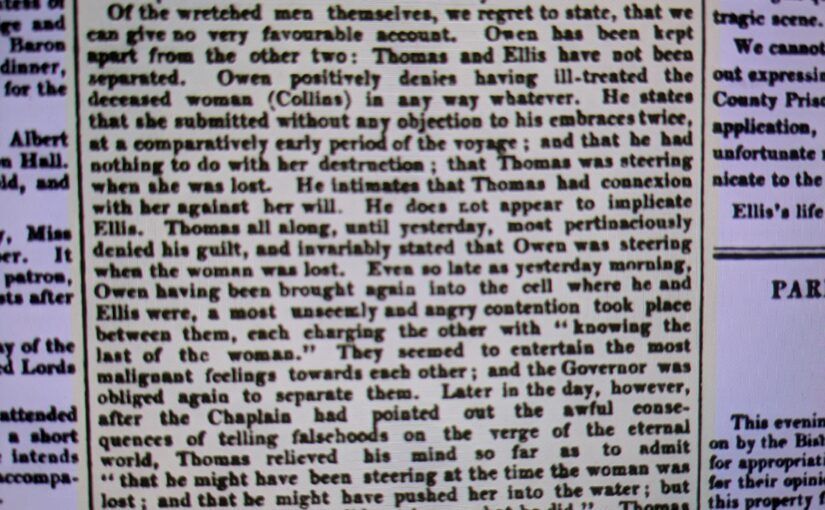
Another week of reading newspaper archives. Hats off to old Godwin – I have found in the Staffordshire Advertiser twice, and the Wolverhampton Chronicle once – the very words that he uses: the men approached the scaffold with firm step and needed no assistance.
Welcome back to: Chris Documents the Documents, as I read archival information about a dead woman with my name. Last week I was incandescent with rage because the main source text on this event seems to have deliberately altered reportage wording. This week, whoops, found it!
Interesting, though, innit. One local journalist refers to the convicts as too agitated to mount the scaffold, while another venerates their firm step. Which is true? Which was right? Godwin made his choice. That there, is another question to ask. Meanwhile, we see that reporting bias in linguistic choices (mark it, year 9) has always existed in journalism. The biases are signifiers of what a society regards as important, what matters, and what does not.
Which lives matter most.
All evening, I huddle in the kitchen in that warm glow the under-cupboard lights give. Its similarity to the dimness of candlelight does not escape me, but I am not always so fanciful; one can’t be in front of a laptop. I drink wine, grimly; I read and wince. Again, in the morning, while the juvenile sparrow that’s taken up a roving residence in my garden agitates the fuchsia, I drink half cups of tea and read. Working through every article on the subject from 1839 to 1840 in order and I still haven’t finished.
What I have noticed is that through spring 1840, Christina’s name all but disappears. She already flickers through the opaque shadows of these careless records; her evasive marriages and homes vanish out of site like someone who has just left the room. There remains a slight change in pressure as the air resettles with its adjusted mass, the only sign someone was there. And after all the accounts of the trial and onto the drama of the execution, she is no longer at the centre of her own story.
Instead, the convicted are centre stage. Who visited them in prison, who wept for them, their conduct, their friendships. This becomes the stuff of literature, the stuff of great themes, these three men languishing under the awful shadow of death which suddenly rarifies their existence. Can I please bring us back to Christina? In the dark of the cabin or the towpath, under the awful shadow of her abuse? Or does it disgust us so much, we would rather look away. These are not men made heroic by suffering. They were the kind of dickheads who hassle you, drunk, in a pub; that follow you home, humiliate you, and if mostly convinced they can get away with it, push you into a corner and put their hands on you. We have all had it. So can I take you back to that, despite the journalist from the Staffordshire advertiser throwing around dramatic statements like, ‘hope of rescue’ as if these men are unfortunates fetched up in some simple peril of a storm or rushing river. They were convicted murderers.
But the cynical approach of clickbait was urgent even then, and the last moment reprieve of one of the prisoners is repeated over and again. The ‘affecting scene’, the friendship and brotherhood, their weeping, their prayers. I blamed Godwin for his portrayal of this source. In fact, it was the papers of the day that really went to town on it; the same words were sold to the Wolverhampton Chronicle, then the Staffordshire Advertiser, on a slow day the following week, published the exact same article again. That drama, that invented narrative; that was left. Dostoyevsky talked about creating romances and stories out of things. This last memory of someone life was someone else’s joyful reprieve.
To be as fair as possible, I don’t believe in capital punishment, either. I don’t agree the men should have been hanged. Look what it makes of the thing! But they were convicted on the evidence; and one freely admitted to raping Christina; he said she ‘submitted without any objection to his embraces twice’. Ah yes. She wanted it; that old line. That was what the Fordingham convicts said, and Everard’s murderer about her getting into his car. Little whores, aren’t we all, us women. It’s what makes us so easy to discard.
If I have ever looked upon you and smiled, then admire; admire and fear my indomitable strength because I smiled in spite of being furious every single day.