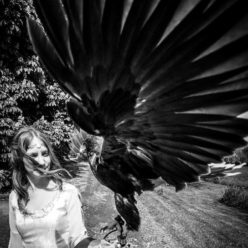
Imbolc

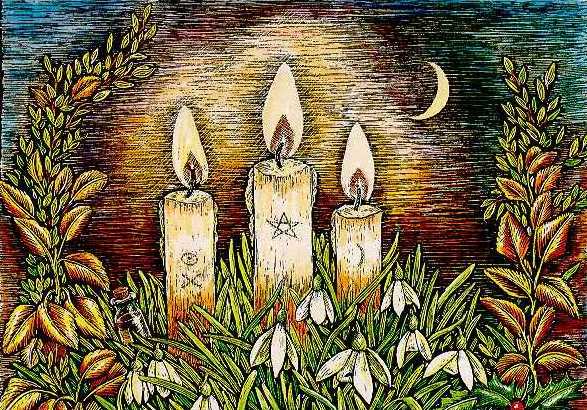
My body has fallen back in with its Northern rhythms. There was Imbolc, brief reprise of snowdrop and crocus, brave buds peeping early, but now winter storms have come again. I sit in a turret, with half a panopticon of vista to watch the winds whip bare birch and oak, the hazel’s pale catkins turning yellowish to play dead. Rain is driven in visible sheets before the woodlands and the brook below rages, plunging its steel grey waters.

This reminds me of other turrets; writing in a Goulburn neo-gothic villa, and precarious above the sea at Eden with the writhing jacaranda. But we do things more quietly here in England. There is no wide ocean passage or endless limestone plain. Just ivy choked trees like a mockery of eucalypt regrowth, the green field, the brook, the rain – persistent, but somewhat tamed. Wind howls in cracks in the windows between the ladybird infestations I’m newly discovering. Magpies gather in nursery rhyme prophecies on the grass below. I read them.

Yesterday, I walked along the canal. Stamped mud up my long brown skirt, drenched it in the rain then it was blown dry again by the end of the walk.

If this is all sounding like a typical bucolic idyll where Chris hedge witches about or tramps the fields to the farm shop like Tess of the feckin’ d’Urbervilles, let me disabuse you.

I have moved to Birmingham.

Without is no wilderness, or whatever passes for it in England. I can see the tower blocks from my windows, and the copse runs to the grey tarmac web of roads soon enough. But undeniably, our new apartment is nice. It has two bedrooms. It has a balcony. It will have birds – although not cockies. It is indeed in a warm, south-facing turret with a marvellous panorama. It is by a large playing field, a raging torrent of a brook, the Stratford and Avon canal and is bordered by strips of woodland. So I get all that ruralish bliss, but because it’s just down the road from King’s Heath high street, the buses also come every four minutes. Winner winner.

Since arriving back in England, I calculate I have slept in about eight different beds. We finally have our own little place, and it’s not even shit, and I’m relieved. Today I have spent the afternoon scrubbing skirting boards and dusting venetian blinds while listening to an abridged audiobook about ‘wintering.’ It’s very Chris. This clever writer even managed to hit upon a whole lot of the insightful comments I already made about winter in my last blog. I tell you, it’s a crime I don’t have my own radio 4 podcast yet. But this writer certainly focused on all the good stuff about using winter to rest and rethink. Wallow, I say. Embracing sadness, stillness, quiet. So I meditated very profoundly on these deep thoughts while balanced on the windowsill until I opened the window to let out a mysterious ladybird and a whole fucken swarm of flies collapsed onto me.

So that was stillness, repose, and very nearly me, right out the window. Seemingly ladybirds are sort of nesting in the window frame. The bit where you open it, on the side there, don’t look too closely, it’s probably where the spiders lurk, although I’ve never worked out how they don’t get squished. But in the case of my windows, there’s an intimidating number of ladybirds crawling over each other, potentially preyed upon by the swarm of flies that also seem to inhabit the area. Perhaps it’s not so bleak. Perhaps they all live in the window frame in some sort of symbiotic harmony, like an epiphyte or something; but I tell you what, they’re not bloody living in harmony there anymore because I poked them all away with a pen lid.

That shall need further Dealing With.

Goodness, this wind has got rather more intense; as has the rain. I shall be able to see a soggy Gentleman walk up the path from here soon enough. Poor man. Have a care also for the poor spider in the left-most window; she has spun her web outside and is being rudely buffeted, but she is an English spider so I don’t need to move out and leave her the keys – she won’t be trying to kill me in my sleep.

Other things I have been doing in my two days At Home is traipse to Lidl and back (it’s like Aldi, chaps – and we even have Aldi in the UK too) to restock cupboards. I thought regretfully of all my nuts and seeds and stacks of food organised serenely in Jen’s Northbourne cupboard, but of course, I’m just glad it didn’t go to waste. Meanwhile, I rebuild my spice collection starting with C and working up.

I have seen most friends since getting back. And shout out to those dear bosom friends of the soul – who keep me in their hearts while I slip away for three years and welcome me home again as if I’d never left. After my mother’s arms and her insatiable pouring of wine, nothing made me feel more at home than reuniting with people who let me just guiltlessly pick up where I left off – who clearly didn’t begrudge my absence but were just happy for my return and the time I’d had. As I get older, I hit happy milestones of having known some friends longer than I haven’t, and there is much to be said for having friends that have seen you grow from idealistic student to embittered teacher and still like you anyway. I am aware I’m pulling a bit of a Victor Frankenstein, here, lamenting that old friends of youth are the only true ones, and new friends are never as good, while he dies by the new friend who rescued him from the ice. Poor Walton. I shall do no such thing – and I hope my Australian friends will stay close as I work to keep the Australian version of me true and open.

Which I suppose brings me to my new job and how my friends are helping me in to that. Having applied to a swathe of jobs, I’ve accidently got one that isn’t teaching. This has been an intense mind shift. Instead of marking mocks and guiding young people towards my leftist agenda through peace, love and literature an’ all that, I’ll be doing a junior admin role with the Open University. Working from home, in my little turret here. Seven and a half hours a day.

The same day I was offered this job, I was also offered an interview for a teaching role with a TLR in a school out past Wolverhampton. I sat down to prepare my interview lesson, I spent two and a half hours in Birmingham library stimulatingly researching the poem to teach, the method I would use, the resources, and realised I had completed only the first fifteen minutes of the lesson. I didn’t sleep for two nights, felt sick on the day of the interview and needed to poo five times before leaving. And that is how I feel for the whole first year in a new school. I am such a fuck up. But I really don’t miss that. The feeling that even after hours of planning one lesson, doing it completely differently might turn out to be more effective. You just don’t know. And there isn’t the time to plan lessons to that extent. And I don’t know what it was, but while I was sat in the inevitable breaktime come-and-bog-at-the-new-teachers session I felt … some of the toxicity of teaching again. The comparing of yourself, the trying to outdo each other, the show-offyness. But that’s all neither here nor there – I didn’t get the job, so junior admin role it is. It’s not a pay cut; right now, I’m on nothing, so it’s a definite pay rise.

I have gone through several waves of emotion on all this. First, I thought of all my marvellously clever friends who are role models and leaders, like Brooke and Claire in Australia, and Jenny in London and worried they might not want to be my friends anymore because I’m not in their league as a junior earner and lowly admin. Then I realised that was not only foolish pride, but also quite insulting to their integrity and decency. Then I felt like I was betraying my beautiful teacher friends like Corinne, Spellman, Emma-wife and Grace by abandoning them. ‘Confessing’ to Corinne made me feel better. Going back to my old school, where my old role doesn’t seem to be … thriving, made me feel worse – I should be sorting this out. Sitting with Emma on the floor of her spare room while she looked like she was about to pass out with exhaustion made me…think again. I love working with young people and sharing literature. But that seems to be less and less what teaching is allowed to be.

Part of me is a bit embarrassed that I couldn’t get a role of equivalent responsibility outside of my sector. Lots of people manage it. I expected a drop in pay, but not quite this much. Hearing other people talk about the things they’re doing at work that sound so important and exciting make me feel a bit ashamed of myself. But I don’t start till Monday, so who knows, my job could be that too.

Ultimately, I come back to Imbolc. The cold part of early spring, where things begin to grow from tiny, vulnerable shoots that may either die or thrive. Yup, I’ve picked a bit of a nervy time to change from a stable, well-paid career to a very junior one. Australia – I’m sure you’ve heard about fuel price increases which are global, but the UK is facing a major cost of living crisis this spring. Whoops. But I am also hoping this job in an excellent organisation will lead to more challenging things. I know there are excellent opportunities in the OU; I applied for them and didn’t get interviews. I’ll apply again.

And there will be growth in other ways. It’s morning now and I have re-established The Routine, even though I lamentably don’t have Hanna anymore to keep me accountable. I was up at six, did a HIIT, washed and was writing this by half past seven. I mean very much to keep up writing and the successes I’ve had in Australia. I will be planning it in and using the extra brain-space and weekends (where I’m too poor to go away) to finish novels and try to develop as a writer. I needs must first buy myself some sort of floppy sleeved linen shirt a la The Death of Chatterton, now that I am going to be a poor, struggling artist. Really lean in to that, you know? But all my life I’ve not had to think much about what happens next, because the term drives you forwards and tells you what to do. Now I must decide. I’ve realised in the last few years how damn lazy I’ve always been, how I actually find it a bit of a struggle to push myself to do things I don’t have to do. I was a bare minimum kid who was lucky enough to be reasonably smart. This will be real growth, real change. It will be hard.

It’s a beautiful morning. Storm Eunice is on its way. Things are lovely, then hard – there is no linear trajectory, just cycles. I will be soothed by sunshine and blackbirds and feel strong and happy and capable. Later, even though I know it’s coming, I won’t be able to stop myself being anxious or overwhelmed or deflated when things are difficult, despite logically knowing it’ll be alright. But I know I’ll survive it.

Growing hurts. This is the lesson of wintering. Poke green fingers through the earth and frost will bite them. But snowdrops grow anyway. So you must poke, try, make, and when it hurts, it’s a reminder you’re growing.

Home

Winter.

It’s in the blood. It’s not so much a season as a state, woven into people; stamped, stained. I know this to be true because I thought this would be harder. Early days, I know, but being plucked from blues and reds of an Australian summer’s sharp outlines and dumped into the moist of England’s winter, I had thought … I had thought I would cry more. But it is something in the body that the cells recognise, they know, they adapt.

It was immediately harder to see. When the pavements, buildings and drab fields are a monochrome grey, smeared with a putrid fog and the sky lingers in bluish twilight for seven hours, I found myself squinting. I rubbed my eyes and cleaned my glasses repeatedly, until I realised the very air is thicker here, and seeing through it is harder – disorientating after the brightness of Australia, where even my myopic eyes seemed buffed clean.

Those were the first impressions. The next, most significant, was that I tested positive for COVID immediately and that fucked up everything.

Thus from isolation, I have had time to contemplate winter. On the narrow, crowded motorways to home, I felt smothered by the very burden of familiarity – a recognition so strong it seemed to supersede the last three beautiful years, to override them like reality asserting after a wonderful dream. Like being crushed by it. It reminded me of walking along Rainham marshes with mum a few years ago, and arriving back in Purfleet, where I grew up. There was a deadening feeling of familiarity, like a weight of inheritance – no matter how far you go, this is you, and this is it, you can’t escape it. My Essex accent asserts immediately over three years of drawling ‘righto,’ bare trees like birch brooms nod, kangaroos and blood red birds evaporate into fantasy and cold is recognised.

And winter. But it was less of a shock than I thought. We arrived in Brentwood, to three sunny days in a row and our invisible, winter-coloured birds of greys and browns singing loud colours I’d forgotten. The sky is a pale blue, the shadows through the white gold light are long like a splendid and forlorn sunset. Light is gentle, moist, fallow. As I spent much of the first day sat on the windowsill I realised I have so rarely passed such a meditative day in winter. Normally I am demoning through mock papers, assessments and trying to think up cool shit for the end of term to try and remind young people that school is not just about being beaten with the exam stick. I don’t look up to breathe – then weekends; even on the boat in the middle of our rural idyll, were frantic all winter with getting water, washing and shopping and then finishing that marking before you lose the light. Or I was drunk, dulling the misery of winter. I can’t think of a time when I have had moments to stare out at the wintry daylight and watch it.

It’s in the blood. You remember what to do. I have lived cosily under a blanket for several days, draped dramatically in scarves. The sunshine is tender and gentle and moisture oozes out the very atmosphere – drink, drink it deep, quench a three year thirst. I’m surprised we don’t all have gills and webbed limbs here; as we swim through a wet cloud that has descended upon us that mutes visibility and the air is wet even though it isn’t raining. My skin feels less scratchy – I will go slimy like an eel. There is no desperate watching of clouds and mapping the hills and rivers to squeeze out every drop. Catchment here means where your kids go to school. So much water. And it is beautiful in its different way. Spiderwebs adorned with drops, that sort of thing; all those cliches. But I can prod these spiderwebs with my fingers without any red-backed vengeance. Yesterday was cloudy and misty so I collected my anthology of vampire tales and sat in the garden, wrapped in more blankets than a Victorian invalid and got my Goth on. It was great. Hot tea, lean into the gothic, blankets, scarves and enjoy the ghostly mists and birds.

Of birds; I miss the cordial friendliness of our cockies and galahs, shuffling over to see what you’re doing. But these bluetits and blackbirds remind me of the importance of stillness. So be still, and watch. Read, write. Stay in, make hot chocolate, get cold so you can get warm again. Winter is not something you screw your eyes up tight to, holding your breath and hoping it’ll be over soon. You have to live it, here. Sit with it.

It’s in the blood.

The Garden of … Eden

A pelican suspends itself against a grey sky thickly smeared with misty forms. I watch it, holding my breath with its static.

There – it has flapped at last and sunk. I can no longer see it behind the thrashing head of a gum, nut-swollen and flinging honeyeaters. The purple jacaranda stands garishly vivid against the resolute rain that thunders against the thin windows.

I am alone.

When rain drums against a deliciously morbid sky, and the wind moans between the cracks in old, thin walls (blow, winds, crack your cheeks!) I think of the loneliness of lighthouses. Long days against the ache of wind and weather, filled with industry and the busyness of routines to sooth the mind – or concentrate it, whatever your preference. Curse the innovations of electricity that stole the lighthouse keeper from their tower! When Darlings lived alone against the storms and rowed the lips of whirlpools to save the drowning perhaps once or twice a year, to break up the tasks of cleaning the glass and metal of lanterns. What perfect profession – to live your life in service to humanity’s salvation, but rarely have to actually talk to them!

I should write a shanty about Grace Darling, or old Tom the Killer Whale, or a Rapunzel tale about a lighthouse keeper.

I imagine a pair of overalls – no skirt and apron to trip over on the one hundred spiral steps – and arranging the day’s metal out in a neat line for cleaning. Two hours a day amid the day’s other duties for twelve in a row to finish, then start again. Two hours a day in a high room, warmed by the glass from every side like a panopticon. I could look up from polishing in any direction, at any moment. Two hours every day, eying the sun passing from one headland of the bay to another to mark the time, singing songs to pass it.

I imagine hot days when the breeze off the coast is fresh relief to the close, moist heat just the other side of the melaleuca and wattle trees where the ground forms dips and hollows on Green Cape. West is emeralds, broken by the blood of bottlebrush or jacaranda amethyst. East; South, is sapphire blue, the eyes squinting against the opals of the sea until dusk eases the ache.

I imagine grey days like this one, blasted from all sides and the thrum of fear as the wind shrieks and waves bark against the impossible red cliffs. Sitting out the watch in the tower – every bit as confined as Rapunzel, scanning, scanning. Not praying for a prince, for rescue, but silently begging the sea to be empty of just such things. For who has to be the hero in this Rapunzel version, but Rapunzel herself? Retiring at last from the watch, eyes sore and body stiff from staring and hunching in the cold, to a warm fire and tea, maybe parsley or lambs lettuce in your supper.

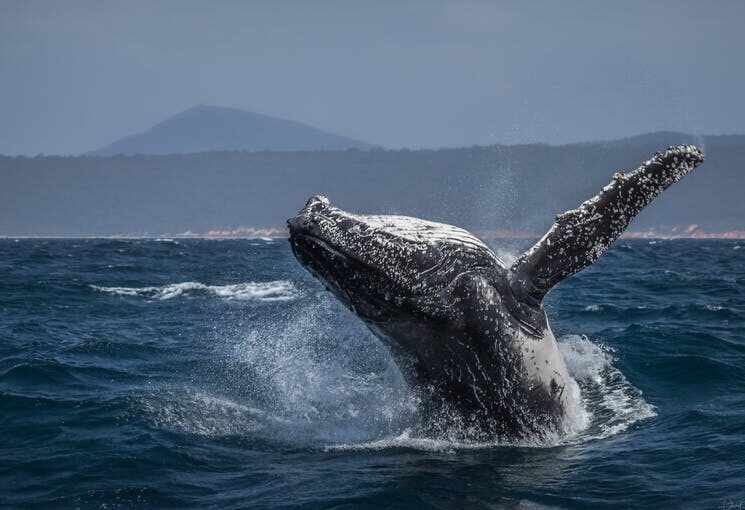
How could I imagine bored children, desperate to get away from the company of all that sea? What life holds better purpose? To run the headlands and forests looking for wombat holes, the refuges of wallabies, banksia blooms and the calls of birds? To watch the sea eagle skim the bay, wheeling above the harbour? And then to take your place on duty at the four-hour watch above the tides and rocks to see the shifting of ages – to wish the migrating humpback whales God speed as they leave, then be the first to welcome them home again when they bring new calves. And if it is adventure you want, what better the rage of a sucking sea that cleaved the hull of the Ly-ee Moon steamer and flying on the waves to heave its passengers out of them? If it’s drink, there’s gin a-plenty. If it’s the brouhaha of the city, what more sociable conversation than the winds?

All this above Eden, which exists only because of the whaling industry. And whales very nearly don’t because of Eden.

Before whaling, it is estimated there were over 200,000 Southern Ocean whales. In fewer than a hundred years, there were 360. While the town of Eden, with its street names and memorial sites will have you think it was down to the acumen of about three pioneering families, the successful destruction of nearly a whole species was actually down to luck, and the deep affinity of the Thaua Yuin people with killer whales. This ancient relationship involved the belief that the spirits of dead relatives became these orcas. When humpbacks or baleen whales swam into the deep, natural harbour of Twofold Bay, the pod of orcas would trap it at one end while the lead bull would jump around a lot and signal to the oblivious watchers in Boyd Tower. The whalers would spot him, then launch their boats to row out and harpoon the humpback, rewarding the orcas with its tongue and lips before hauling it ashore to harvest the oil and bone. Before any fanciful narratives about intent can get carried away, there are lots of examples of predator animals that work together to hunt, like wolves, hyenas, prides, and several that cooperate inter-species for the same purpose. The spotted antbird of Costa Rica observes, follows, and benefits from the movement of ant swarms to eat crickets and invertebrates, and there is the honeyguide bird in parts of Africa that works with humans to locate beehives. Driven in part by instinct to eat, animals can learn.  

Thus, it was these orcas that were the heroes and cunning hunters. Not the men that for seventy years made a fortune out of their exploitation of whales to the brink of oblivion, then obviously lost everything when there was nothing left to hunt. And the killer whale gets a real good rep in the town’s killer whale museum. More, in fact, than the Thaua people. Referred to throughout as ‘Aborigines’ and spoken of with some reverence in regard to their hunting skills and their ‘superior eyesight’ (I’m sure this was empirically verified), there is no mention about the treatment of these people and what happened to them when three families set up docks and stockyards and grazing on their land. It brushes over their employment by the Davidson family; one quotation refers to their payment of ‘slops and food.’ Well, confronting as it may be, and whatever the intent was at the time, that does meet the unfortunate definition of slavery. There is a small set of boards dedicated to Aboriginal dreaming in a very generic sense, but no representation from local people (I must be fair; there was one piece of art by a local Yuin man) that instructs about the specific life of the coast people, or offers recognition about how this brutal and short-lived industry impacted them.

As well as the blind spot on the First Nations people of the Sapphire Coast, there is another partial blindness to the brutality of whaling and its impact on the species. There is one board that notes the difference in numbers before and after whaling. And some pretty, wavy writing under a lot of other text that said Australia does not support whaling, but nothing joins up the two. Nothing offers recognition and ownership of the reality that it was the industry that did this. Eden did not make a conscious, conscientious, conservationist decision to stop whaling. It stopped because there were so few left it was no longer a viable industry.

But this blindness or silence on that salient point, and the contrasting wealth of information given about the uses of whales, how they were killed, who killed them, how big they were, along with unavoidably romanticised paintings and poems with a healthy dose of ‘rush-o!’ and ‘thar she blows!’ presents the industry and heritage of this town as undeniably glorified. I’m sure it was all very exciting and dangerous, and they were very brave and strong, and real men and all that – but where does it leave Eden now? Struggling to refocus its identity, it has turned to trawling – until we run out of fish too? and logging – until … ? when it could have led the way in whale conservation and remodelled on progressive science. On the direct migratory routes of several whale species, it is uniquely placed to be a centre for marine research and conservation, not to mention tourism. But admittedly, even if research became the dominant industry in the way that education centres sometimes can, it might not be for everyone. In a town that defined itself by the meaty, manly history of whaling, a research facility may not provide the full scope of options for your average bloke looking to understand who he is, how he fits in the world and how he can contribute to it.

The lighthouse would have been perfect.

Forest to Reef

Cape Tribulation is sold short by its name. Maybe it’s the getting there; it must be the getting there. You cross the Daintree River on a charming little ferry – it’s seriously croc infested (the river, not the ferry) – then wend along a narrow, windy road. High rainforested hills sweep up to your left, the coral sea glitters out to your right. It is, apart from perhaps that veranda at Red Mill House, the most enchanting place. This cape exemplifies the Australian specialisation of beautifully sweeping curves, and honest-to-goodness palm trees on sand so white it hurt. Then the blue, blue, blue.

We spent an unforgivably luxurious afternoon paddling (on the safe side of a sandbar, in water an inch deep), practising handstands (I don’t know why this has become a beach tradition of ours) and I read while the Gentleman built a little fort with a good coaching house on its little road. It was just extraordinary; you must ask him about it. A rhythmic knocking above our heads caught our attention and we turned to see another black butcherbird butchering a coconut. It fell down and cracked. We actually picked it up and drank the water that trickled out of it, like a pair of goddamn children-of-nature. Freakin’ idyllic. Then we strolled along the Dubuji track – a boardwalk through the mangroves which was also captivating. We had been assured by a girl at the servo next door that we might meet a cassowary. I’m not sure I want to meet a cassowary, I said. Oh, they’re ok; they’re pretty curious, she said, they can come right up to you. I’m not sure I want them to come right up to me, I said, they can bloody kill you with one knife edged foot. In fact, if I see one, I want a clear space in the other direction and nothing stopping me from keeping it in clear view. What I don’t want, is to be trapped on a narrow boardwalk surrounded by snake-infested swamps. But she assured us it was fine, and, not knowing if this was again the risk tolerance, safety reality, or actual bloody ruthlessness of northerners, we shrugged and went.

A word on mangroves. They are hauntingly lovely places. I don’t know why haunting, I’m trying to resist an inevitably gothic comparison, and in their deep, moist shade there is something gothic, something shadowed and mysterious. But not threatening. I don’t know, maybe meeting Kuku Yalanji people, reading about Aboriginal culture and meeting lots of people talking about their culture means that a person never again can approach the spaces of Australia with the attitude of Joan Lindsay in Picnic at Hanging Rock or… or bloody Lawrence. It is vast, but it is not an unknown place of terror to be conquered. It is deeply, deeply known, and deeply loved by people who have known and loved it for thousands of years; who will share that knowing and love. It’s something I can feel. Ok, chaps, fade back in, I’m finished, either way, the mangroves gave me that tingly feeling of excitement that forest river pools give me when the words of Jenny Greenteeth songs slip into my head.

Right, and THEN we shot down to another campsite that had freakin’ fresh stone-baked pizza, so we smashed two of them like a pair of hungry bastards, crushed a couple of beers and watched the moon rise over the sea. JESUS, I shouldn’t be allowed such loveliness. Then back at our tiny little cabin at Safari Lodge (this place, despite being waist deep in rainforest, does an awesome almond flat white, breakfast fritters and noodle salads), we sat outside in the dark watching little marsupials nip in and out of the bushes.

After visiting ice cream making fruit orchards and tea plantations, and getting MANGED (eaten by insects, as the Gentleman calls it), we regretfully left the rainforest. Yeah, I was pretty gutted. I could have stayed there another full week listening to the lolla-palooo calls of wompoo fruit-doves and the oli-oli-oli calls of the olive-backed orioles, the ever-present peaceful dove, and the sound of the sea. And the drive was the last chance to listen to Murder Ballads all the way through, so, heart break all round.

I have never been snorkelling before.

As a child, watching The Little Mermaid like all children do, except, apparently, the Gentleman, I thought being able to breathe underwater and chill with fishies would be just awesome. The sort of thing ya couldn’t drag me away from.

Turns out, it’s a lot harder than I thought.

At the age of 15, I discovered that getting out of a wetsuit is one of the hardest things a human can do in their life. Twenty-two years later, I bloody stand by that. On board Coral Sea Dreaming, I dragged the horrific latex thing off one shoulder, and it took me a bit too long to realise that in the struggle I’d whapped a bap out, which was, unbeknown to me, enjoying the sea breeze completely unencumbered by my bikini. Of course, I did what any dignified adult woman would do, which was exclaim loudly in horror, oh shit, look! I’ve pulled my boob out…

Christ, Chris.

But I’ve noticed that in the telling of my adventures to chums, that snorkelling on the Great Barrier Reef – a lifetime ambition for any human that has ever seen Finding Nemo – consistently comes last. This is not just because it was the last thing we did. I’ve been pondering. I think because it is so otherworldly, so unlike any thing I have ever done before, that I don’t know how to explain it. I haven’ learned how to tell it. There is no point in a human’s life when you are lying flat, facing down, and watching things move ten feet below you. Floating face down and looking, seeing, is not something humans are built for. It’s completely unique.

And a bit fucken scary.

First you put your big old goggles on, and there’s a bit that goes over your nose. This, as we know, is to close off that orifice so you only breathe through the tube you put in your mouth. Of course the minute I put the goggles on, I tried and failed to breathe through my nose, which made me panic, then putting something huge in my mouth was pretty uncomfortable. Oy, stop it. Then when you’ve figured out a few breaths, you do what you are taught from birth never to do, which is put your face straight down into the water; and breathe in.

Bleaurgh. So I got the hang of that a bit, even graduated away from the pool noodle, but I managed to keep sucking in sea water, so I’d panic and surface again, and stare out over miles and miles of open, wide sea and feel lonely and scared with the waves breaking over me and my toe rubbing roughly against the flippers as I tried to stay upright. The impossibly tanned, impossibly beautiful young people on the boat were very kind about my ineptness and the lovely long-haired young man told me to pout more, as if for insta; that stops the water coming in, he said. Millennials and their adaptivity.

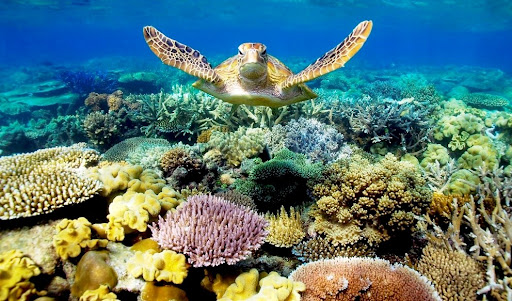
Eventually I calmed down a bit and got to stare at some fishes. We saw a beautiful little turtle, frowning in that wise and thoughtful way that they do. Not towards us, like in the picture above. In fact, he took one look at us and swiveled round right back where he came from. Gracefully. But disdainfully. Huge coral plants had tiny little fishes darted around out of time with the current and tides. We rounded over big bommies (like under water mountains or something) and swam right into huge shoals of fish of every colour. Some had hilarious bulbous heads, like really big foreheads or frowns. Others were gracefully tiny, all blue with yellow tails. The implausible parrotfish were shimmery purple and green. A little whitetip reef shark shimmied its way below me as I stared down.

As we got more used to it, I suggested we just sort of hang out in one place and watch. And that was wonderful. We lay spread-eagled on the surface, breathing carefully, and feeling ourselves being gently buffeted by the current, left-right-right; left-right-right; left-right-right. With all the fish that were doing it too. Left-right-right. Left-right-right. For days afterwards when I closed my eyes, there was that gentle surrender of left-right-right, with an imprinted halo of cold around my head where it peeped above the water, the weightless feeling and the fish left-right-right-ing with me.

One thing you don’t expect is how soooooore your foreheads get from the goggles pressing deeply into your brow, and your teeth ache like hell for hours afterwards from clamping down on your snorkel tube for dear life.

But the whole affair was delicious, hours of cruising across the sea and bouncing on the purple-blue with the green rainforest mountains behind us; lolling in hammocks reading books while a whole freakin’ pod of dolphins followed the boat, writing, making new friends, squealing over a minke whale that came to explore what this funny, big, whale-like thing was that ejected these funny little spiders. Oddly, the gender balance was completely the opposite from the Kimberley trip, and it created a different tone. I took my customary role as group gob-shite, and a wonderful woman, Margaret, who was #vanlife-ing her way around Australia (because she was wanted at home, not needed – isn’t that beautiful? Life goal) gently teased the only men into submission and quiet.

We all drank a lot of beer, ate tacos and watched the full moon rise over the sea. And I fell asleep trying to think of ways to describe the gentle, endless left-right-right as the waves gently tapped the boat in an eternal game of It.

Cairns Capers II – River Rollicks

With a special shout out to the beautiful big dog that lived in our dear little hotel, Le Cher Du Monde, in Port Douglas and some more northern madness on the heaving 4-mile beach that had a big a-frame board saying, ‘beach closed, croc sighted (water temperature 28 degrees)’, we were off next to Mossman Gorge. It was delightful, gorgy – ya know. No crocs up there which was a bonus, but that’s because it’s cold, so that’s shit. The trees have enormous, buttressed roots in the rainforest with vines in ornate patterns, and we found a lovely green pool off the main, rushing, dangerous river and got in that to cool our feet off. Then off to Daintree Village where we spent a joyful afternoon walking in slow motion down a country lane clutching a flier about local birds following the call of an oriole and a wompoo fruit-dove. When you see me, ask me to do my impression. You’d never believe a bird could make that sound. We also scored dinner in a ridiculously fancy restaurant – the sort that over adjectivizes its dishes but under fills them – because it was the only one open in a 10km radius.

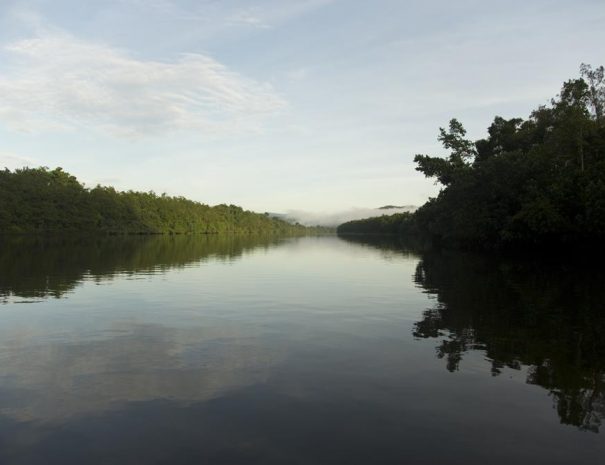
Early the next morning we were stood on a wooden jetty by the river. Under the moist, grey sky, the air was gentle and warm; mist capered charmingly against the hills where flags of white cockatoos waved, and the green river mingled with the green banks and trees. I was positively trembling with excitement.

Here at last was our dawn cruise on the Daintree River Experience, run by the charming and expert Murray. I had been looking forward to this so much, for a year, in fact – when the world went silly and borders shut last July, we exchanged the Daintree and Barrier Reef for the empty lakebed of Mungo bundled up in hats and scarves, and I sat by my campfire muttering that I should have been on a sodding boat cruise looking at sodding birds on the sodding Daintree. The exalted moment had come, and, like the Kuku Yalanji Cultural Habitat Tour, it was The Best Thing I’ve Ever Done. Can you iMAGine my excitement when he handed me a little clipboard and pencil to tick off bird species – I nearly lost my goddamn mind.

Murray is a prince of the river. He steers his boat masterfully and cuts the engine just as the turn is made so the momentum takes you soundlessly within an inch of the eyes of birds. Over two hours we saw kingfishers, flycatchers, a great-billed heron, frogmouths, a green tree snake (that is not green and has a yellow belly, but, in a break from common Australian nominations, is surprisingly not called the yellow-bellied tree snake), a baby crocodile, a … very much granddaddy crocodile, and, very memorably, a black butcherbird capturing a white-lipped tree frog. This was rather brutal, so we gently steered away from Barratt Creek and nature’s rough cruelty and instead stopped round a bend to admire the mists smeared over the mountains. Here – best of all – we were told unequivocally to shut the hell up and quietly take it in.

Time drew on, however, and those who know me well and have endured me on motorways and federal highways know that morning is my peak, ahem, evacuation time. And there comes the moment when I am so desperate that I stop having fun and my silent need is so loud it’s fog-horning in the driver’s ear.  

Needing to wee when you’re in the middle of a seriously croc infested river is no laughing matter.

We disembarked in a cloud of flitting welcome swallows that landed on the very boat where we sat, and bent double, I renewed my intense gratitude, regretfully returned the clipboard and hobbled off, half hysterical, to a convenience. Then back at our little bed and breakfast our charming landlady cooked us breakfast – even though we’d technically checked out – and I enjoyed the discovery of custard apples, sitting on the veranda surrounded by Ulysses butterflies, orioles and sunbirds and beautiful flowers. Red Mill House Bed and Breakfast – I can thoroughly recommend.

Cairns Capers – A Pentalogy in Three Parts

In yet another (not terribly arduous) struggle of being British in Australia, I am often disorientated by a common pronunciation of this far north Queensland town and assume the Australian speaker has moved the conversation on to the French town of an independent film festival.

I don’t know how many of them are looking at me askance when I persevere in mind of a piled stone way-marker, perhaps because down here I’m untroubled by the facial expressions that may be occurring high up in the stratosphere which are no concern of mine.

Maybe it’s just a Queensland thing.

However the hell you pronounce it, this part of Australia is a pretty bloody amazing place. Salivating on the memory, I am currently in a Ken Behrens (UK – google this …) lockdown, enjoying a bit of late morning sun from the balcony and admiring the austere sides of black mountain with its cloak folds of grey-green eucalypt. Vivid yellow wattle competes with the blue of the sky to challenge the high country note of frost in the air. As winter races towards spring, the mournful cry of a raven keeps me in European thoughts: seasons, the gothic and the now-familiar: dryness, drought, fire. Queensland is tropical and it’s utterly disorientating.

Flying to Cairns/Cannes is worth the ticket just for the view. Screw paying for helicopter flights, just pay attention before you land. There are vine drenched mountains in lovely peaks like whipped meringues that glow purple-green against a blue sky and sea. It all sparkles like it’s been glittered for the occasion and is just like those pictures of paradise a girl from Essex would stare at, never imaging she would really one day see.

We hired a car, got Nick Cave and the Bad Seeds blaring like two respectable road trippers should, and set off. Our route was north to Port Douglas for two nights including a cultural crab-fishing tour on Cooya/Kuya Kuya Beach, a stroll around Mossman Gorge, bird spotting on the Daintree River, up to Cape Tribulation, then back south to Cairns to hop aboard with Coral Sea Dreaming for a day and overnight of snorkelling at Milln Reef on old Great Barrier. And singing la-la-la-lai, a-la-la-la-lai, we were off on another round of croc dodging!

* * * *

‘You know vegetarian is an aboriginal word, right?’

Brandon is looking at me devilishly. I sense a trap.

‘No?’

‘Yup – it means really bad hunter.’

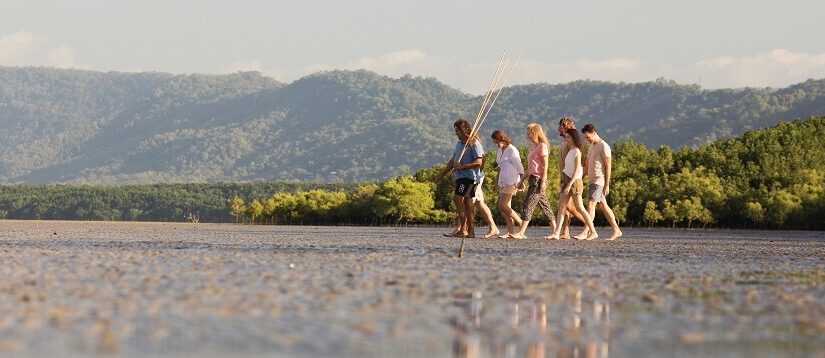
Yeah, fair. But I don’t know how he does it. Brandon Walker and his brother Linc have run Kuku Yalanji Cultural Habitat Tours since 1999, taking people out onto the mudflats to share traditional hunting and cultural practices. He said his grandparents taught him to hunt crabs on the mudflats of Cooya Beach from the age of five. They’d grab me by the ear, he said, tell me to look there, look there, and twist, he said. He learned pretty quick. But when he points out to me the serrated curve in the sand under two inches of water, I reckon I could have walked over it a hundred times and never known a blue swimmer was hiding under the sand. Poke it, he says. I heft my little spear and prod, uncertainly. Ooh, it didn’t like it. The outline suddenly swells three times its size under the sand as it spreads its pincers. Shit. Go on, stab it, Brandon urges. I do it quickly before the bugger can think about it. It was a good hit, I got it through and with a pretty impressive perspective angle, the photo looks like the crab’s half my body size. It wasn’t, but still, I killed it and ate it. I’m not vegetarian, and so much for finding the whole experience confronting, coz I fucking sure showed that crab.

This was my triumph of the day but spending the morning walking along the silver mudflats was good enough on its own. The sky was thinly clouded, and the air was warm and balmy without being fierce. There were so many starfish I could barely avoid treading on them, and memorably, a bull-ray swum right into my shins as I waded through the water.

Just remember I killed that crab. Don’t think about the yelping and shrieking I did, then.

Brandon impressed us all again when he threw a spear into opaque water while accounting for refraction and got the ray in its right wing. He removed the poisoned spar from its tail and threw the little fellow back into the water where it swam away to … heal. He promised. He also promised that the 5m croc that lives over in that estuary and the 4m croc that lives in that other river mouth won’t come onto the mudflats while the tide’s out. Righto.

We collected periwinkles and wirrells for eating and pulled black pearl oysters off the mangrove roots which we shucked and sucked then and there. We ate hibiscus flowers for their quenching flavour, and he showed us how to squeeze drops from the white berries of beach cabbage into our eyes to soothe soreness. We fell over little soldier crabs and held puffer fish in our hands and saw the marks left by dugongs with their young. Brandon told us about his grandfather from the stolen generation; how he was taken from his family but escaped and ran back to his mountains and forests and beaches; how his grandmother was carried right past the officials in a dilly bag; how he has lots of children because his grandfather impressed upon him the notion that ‘they’re trying to kill us all. Spread.’ He told us about travelling around the world, getting up to capers in Manchester, playing professional rugby, playing rhythm guitar and how to tell the weather by looking at the cloud on the mountain. It must be so wonderful to know this is your home, you belong here, I wondered. He smiled. I can just about bear it, he said.

After about two and a half hours it was time to go – but no it wasn’t, because he took us to his folks’ house over the road and cooked all that good stuff up with a brick of butter and intensified garlic and chili marinades. We slurped it all up with deLICious fresh damper, chucking the shells into the bucket between our legs, while Brandon made us jewellery from the wirrell shells we’d collected. He was a legend, his family were lovely, and it was pretty much the Best Day Ever.

After this we went to ‘Wildlife Habitat’ in Port Douglas (it’s a zoo, it’s just a zoo) and I nearly passed out with excitement when we entered a room filled with free-flying birds. I could have stayed there forever dodging wood swallows, finches, and doves while staring at little quails and the bush stone curlew, but the best little chap was a cockatiel who came and sat on my shoulder for about 20 minutes. Wandering around we also saw cassowaries, eclectus parrots, royal spoonbills, lorikeets and black cockatoos. Yup, lost my mind.

Gift of the Gibb – Part II

The joy of the Kimberley is wilderness. That is why people go. Our little troop, loud on port and gin often disturbed the peace and quiet so I didn’t get my bird-geek on, but trees and flowers are not frightened of general carousing. Boabs were a wonderful discovery. I’ve seen images of these, often in paintings, or they are described in poems and stories where someone is sat in their shade, but despite their hype as the truly iconic Proper Australian Tree, they are …pretty ugly. Or so I thought. They are wide and squat in the trunk and often depicted with dead looking branches bare of leaves spread like a crucifix under a punishing sun on the dry, dry, endless red earth. Give me the moist green of a jarrah, or the whimsical fronds of yellow box gums. Not this blasted, bleak thing.

I have been converted. We arrived in Broome at the very start of our trip on a warm night, fragrant with frangipani blossoms (which I thought only existed in Marquez novels), overjoyed to be released from the grip of a Canberra winter into the purple open palm of the Indian ocean and its scented breezes. The first boab I saw was thickset of trunk, curved like an old woman – like an apple, and abundant with leaf. Like a green plume, ornamented with huge, creamy white blossoms frothing with a thousand long stamens. It was beautiful. I have never seen such a friendly looking tree; and friendly they are, being filled with water in the desert. At El Questro, someone has helpfully installed a tap in the trunk of one such tree and the water was pure and clear, and a lot tastier than what came out the tank of our bus. I want you to imagine Terry Pratchett’s Nanny Ogg-made-tree, opening her arms out to hug her children because that is what their wide, wizened, warm and friendly trunks remind me of. The boab nuts which endure long after the leaves (and apparently should NOT be eaten before some serious preparation) hang like Christmas baubles and gifts, reachable between the cleared branches.

As well as the landscape of pink wildflowers, yellow cotton flower and embracing boabs, there is a universe of stars. One of my favourite bits of the trip was going to bed. We have, at last, joined the ranks of Aussies who rave about ‘swags.’ This word is so ingrained in the Australian dialect that they don’t even think to modify it to people like me who think they’re talking about an elaborate curtain arrangement. I have been initiated into the mystery: it is a heavy-duty canvas sleeping bag, for your sleeping bag. There ya go, that’s it. You unroll it, it has a sort of sewn-in foam mattress layer which is comfier than any amount of money spent on blow up/pack down camp mats, you put your sleeping bag inside it, then fight your way through two sets of zips to get in. Exciting for early morning wee urges, useless against mosquitos, hardly lightweight portable, but, you know, if you want to get romantic about it, we could call it a star mat. Because that’s what it’s best for, snuggling in comfortably and watching the universe. On our first night the sky was lit an unreal purple, with the clouds and studs of the milky way tangled up between the branches of a boab glowing silver by the sky. One night after returning from the loo, I watched stars shoot in slow motion; one for up to 8 continuous seconds. What a beautiful way to fall asleep. Another night, I heard dingoes howling. This is less comfortable. I remind you that I am just lying on the ground, face exposed to the nocturnal exploits of wildlife with no walls to divert attraction. What if a dingo nibbles my toes? What if a snake slithers over me? Sleeping on the ground in swags was another thing we would not have done if we had not been with Daddy Damo, and of course, snakes try to avoid big, vibrating things like us.

All this came to a head one night when I saw a croc in the campsite.

Our little camp spot on the well-ordered, well amenitied, boozed up El Questro campsite was right by the river. This is the Pentecost River that Definitely Has Crocs, and after some very scientific finger measuring on the map, the campsite’s location on the river is far less than that all important 100km away from the sea. We unrolled our swags beneath a tree a mere five Yates-Paces (YPs) from the bank itself. I’m sure it’s fine, I said, if they had a pitch where people kept disappearing, we’d know about it. There was a swimming part of the river, with a sort of wall built into it with rocks to protect children from crocs. I refer you above to the bit about crocs crawling up waterfalls and you sure as hell wouldn’t have got me in there. But they’re ambush predators. They don’t sneak out of the water to drag campers off. I’m sure it’s fine. Sure. I slept with memories of brolgas flying into the sunset, the starlight. Then I came back from me midnight wee.

Two little red dots were staring at me from the middle of our camp stool circle.

We’d had a tour of a crocodile sanctuary in Broome and the chap had told us; if you’re camping and you get up for a piss and see little red dots glowing in the dark, those’re freshies. Don’t panic too much, it means the river’s good, you’ll have good fishing, but if they all disappear one night and are replaced by two yellow dots, then get the hell out. Still. Two little red dots more than I wanted to see. Perfect, glowing red dots, and nothing between me and them. I woke up the Gentleman. Dude, get ready to run. We stared in horror together and he stood up for a better look. Three, glowing red dots.

Our campfire was a metal barrel with regular holes drilled in the side along the bottom for air. It was still glowing. Panic over.

Purnululu sounds like a song, doesn’t it? What a lovely word. This was our most remote spot, the campsite was a shed toilet and a tap, defo snakes everywhere I’m sure of it, and the home of unique, layered sandstone beehive shaped rocks. Those that have been to Kata Tjuta’s many heads – it was much like that, you walked through a city of rocks cutting their blades on the blue sky, but they were red and black striped. I wonder if you could learn every rock, every tower, every shape. It was beautiful. These skyscrapers of stone bubble up from the plain in a group, surrounded by smooth, flat land filled with termite mounds and melaleuca. We did some beautiful hikes across the empty Picaninny creek to the look out, then through a maze of flowers to Cathedral gorge and Echidna chasm. Cathedral gorge is the end of a creek where during the wet season a waterfall spills over the top to join the creek and has cut out this huge open cave with pretty amazing acoustics. Greg sang Meatloaf. I sang The Cruel Mother. I don’t know why I chose a sad song. Aren’t the rocks sad? They have watched for so long. Echidna chasm is a thin gap between two walls of red stone, cool and shady, with that same Uluru red AF and blue AF contrasts and finches flitting between the cracks and trees. I write lots of reports commending people who have ‘strategic overview’ who can ‘see the bigger picture.’ We got an expensive 18-minute helicopter ride to see the ‘bigger picture,’ but the lasting joy comes from the close-up details; tufts of tiny white and maroon dry flowers, the stamens of blue petals, the different shades of crimson.

Lake Argyle was the last main stop. Science: this a man-made lake. Insert other info here, about failed agricultural intentions or whatever. For us, this was yet another stretch of water we got in, then out of and then saw crocodiles. Fuck sake. We jumped in the water, we saw freshies up real close; little, short-eared rock wallabies with their joeys on the stones above us and we lazed in the water as the sun went down. Aussies have a cute thing where they chuck a ladder over the side of a boat and lazily announce, pool’s open! I like that. But I really liked being on a boat full of adults shouting, ‘Yeeesss, that one spat at me!!’ There were little archer fish in the water which have great eyesight and will spot crumbs of bread if you hold them out. They use this superpower to spot flies hovering above the water’s meniscus and spit water at them like a missile to bring them down for eating. They’ll do this to bread holding humans, too.

Our final day was in Katherine Gorge, Nitmiluk park’s thousands of bats and Edith falls for one last gorge dunk. This was every bit as lovely as any other gorge, but it was now melancholy with the thought of leaving, of saying goodbye to new friends and sadly recognising that you will not laugh at another of Graham’s puns, or hear another of Greg’s songs, or see another unique pair of boardies from Ben’s inexhaustible wardrobe.

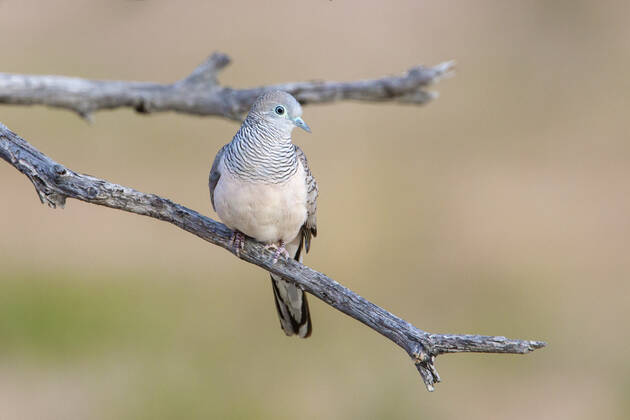
The wonder of travel sometimes, is when it’s over. I’m not sure I really believe this, but I do believe that the important part is reflection and that needs time and sometimes, distance. What images distilled in your mind? What now will be the thing that will pierce you with the briars of nostalgia? It’s the bird geek in me talking, but every day we were chased by the fluted hammer-on call of a bird which now holds in its round notes the heat and smells and yellow flowers of the Kimberley. I was overjoyed when I finally tracked it down in Darwin’s beautiful botanic gardens; a blissful twenty minutes of standing still, listening, looking, moving slowly, and spotting it at last up in the fork of an unromantically spikey tree. I could see its little throat move so I knew that was definitely that ball of feathers making that sound and I could see enough to identify it as ‘something like a pigeon’ so I could start googling doves of the NT and finally call it by its blue-eyed name: peaceful dove. This is why travel is important. You learn about people and things you didn’t even know existed. Another fact I learned that I can’t seem to shake was from our boat guide telling us that Lake Argyle should rise by about 6m every year during the wet season. But repeated drought over the past 8 or so years have replenished it by a mere 30cm a year. Can you imagine that? SIX metres down to 30 centimetres for 8 years. Even this incredible wet season’s efforts of raising the water by an impressive 9m has not brought it back to pre-drought levels. Guide Damo told us that in his 7 years driving people up and down the Gibb River Road, he has never had to swim across Tunnel Creek, and he has no idea what all the wildflowers are called because he’s never seen them before. I hope he sees them again next year and our joy at them wasn’t luck. But increasing drought, and it is caused by increased burning of fossil fuels raising temperatures by over a degree (look, that’s the science, and confirmed by a real geo-paleo…super scientist we had on the tour with us), means those wildflowers might be luck, and those changes are stripping a lot of beauty and colour from the world. And going back to my little peaceful dove, what if they disappear too? This is another reason why travel is important. When you find something new and beautiful, like that blue-eyed, fluting bird, you want to protect it. You’re connected to it, you named it, or held it or touched it, left a bit of yourself with it.

Allowing its death is to permit the death of a bit of you.

Gift of the Gibb – Pt 1

‘So this is it, guys! Jump in.’

In, he said. Well, I didn’t quite know what ‘in’ was. I couldn’t see my hand in front of my face, and I was cold and needed a wee. I was aware that there was water of an uncertain depth ahead and while I’d like to use the old metaphor of ‘inky black;’ maybe chuck in a ‘gurgling’ to describe it, I’d be lying because I couldn’t see a bloody thing. The light of my feeble headtorch patchily revealed that the valiant Damo – our guide, had stripped down to his shorts and boots and was rubbing his hands together between hunched shoulders. Then that image was gone pretty quick, lost to the gulping blackness. Apart from the wobbling, unenthusiastic glow of his headtorch ebbing away, I could see nothing else.

I stood on the sand, with the Gentleman nudging me; go on, Chris. But why the fuck, I thought, am I in a pitch-dark cave at 6am about to swim in a flood-swollen, frozen creek infested with goddamn crocodiles?

Well, I didn’t want to be left in the dark on me own for a croc to find, so in you go, – and I did that thing I do when getting in water (only recently discovered, as entering the inclement waters of the Irish, Atlantic and North Seas is not something in which sensible Brits indulge), which, it turns out, is hyperventilate the words ‘shit! fuck! fuck! Ok, I’m in, I’m in, shit! fuck’ and there you are, aloft, kick, swim! Hope your boots don’t weight you down, don’t think about the crocs and get to the other side.

This was the first major spot on our tour of the Kimberley; heading from Broome to Darwin: Tunnel Creek. Despite arriving at the stretching crags of a 350million-year-old coral reef at dawn, swimming that cold creek wasn’t even the first impressive thing I’d done that day. No. That was to meaningfully pick up the shovel and disappear off into the bush. But I’d been keen on getting to Tunnel Creek – I’d been lent a book by my shanty man Bruce about the Bunuba people’s resistance to encroaching and violent pastoralists in the 1880s, led by the heroic Jandamara who evaded capture for years by hiding in these caves. I dunno if he had to deal with crocs. And they were certainly there; as we followed the creek’s strips and pools, careful not to stumble and reach out for the wrong half naked person in the dark; little red eyes at the edges of the caves where they cringed, spread like butter against the walls. Bloody hell. And then walk towards the light, and relief dripped off me, along with the water, as daylight emerged at the other end of the tunnel, festooned with trees, littered with heron and loud with peace. Until Damo pointed out the long, deep imprint of an enormous reptilian tail in the sand, heading from whence we’d come.

‘Right guys, back through the creek again, then!’

FUCK’s sake.

On our way back, we encountered three noisy lads on giant, unicorn inflatables with tinnies.  Now we’ve read a lot about crocs, or ‘croncs’ as the Gentleman has affected to call them. Salties can live in fresh or salt water and have a gland that removes the salt. They can come up to 100km upriver. They like to eat small calves, or wallabies, or wallaby sized humans like children and Chrissies. They can lean back on their tail as if it was a fifth leg, just like kangaroos, so pealing you off the roof of your ute isn’t much of an issue. They can even, apparently, climb up waterfalls. Jesus. We have agreed that, along with its weather, you don’t fuck with Australian wildlife. The hippy mantra ‘they’re more scared of you than you are of them,’ rather underestimates the boofhead courage of your average 5 metre fucking salty. But here’s an observation from The Brit Abroad, West Australians and Northern Territorians certainly have an impressive risk tolerance. Or commendable courage. Or they’re just fucken nuts. I pondered the gleeful shouts of those floating blokes the next day while drinking a cup of tea by the bank of the incomparable Manning Creek at 7am, breath caught by the misty golden beauty of the morning. Little fish swam right up to the edge where I sat, then spun round to rub their backs on the sand and flash their silver bellies to the sky. I sipped me tea and watched a white egret on the rock in the middle of the river, patient and still, next to an equally motionless penguin. …   …    …   Why the hell is there a penguin in the Kimberley. I shaded my eyes from the sun, and it shifted, revealing the long neck of a white bellied cormorant. Righto. Animals are secretive and deceitful in this country. Remember that, Chris. What else do you need to remember? Shit. Eyes widening, I hastily interrogated the sand. I couldn’t see any croc tracks, but I took the opportune moment to get the hell away from the river’s edge.

More on crocs later.

We stayed at Manning Gorge two nights. The first day began with an hour’s walk down to the waterfall to go for a swim in the gorge. Damo was pretty convincing about toughening up – you start the walk by swimming across the creek, he said, you’ll be right, he said – there’s little blue barrels to dump your gear in, then you can just hang onto them and kick if you can’t swim. It’s hot, you’ll dry out in no time. Far out. But having done the same thing the day before in the pitch freakin’ dark and much colder water, this was, er, too easy, as they say, so in I got. It was a beautiful river, surrounded by trees, rocks to laze on, birds and the blue, blue sky, I was actually pretty energised getting in. Refreshed, we hiked over the hills through pink wildflowers and cotton flower trees that bear pretty yellow blossoms (right on the end of the branch, with no leaves; imagine a magician’s wand when it spurts a bouquet out the end) and eventually got down to the waterfalls and swimming pools of Manning Gorge. It was glorious. Red, red rocks curved their arms around us, and slabs floated in the water, sprouting shady young, green eucalypts. Vivid scarlet dragon flies landed anywhere you threw your eyes. Fishes swum up to the rocks and gawped at us and rainbows capered in the waterfall’s spray. Like, ya know those screen saves on your computer of magic places you don’t really think exist? It was just like that.

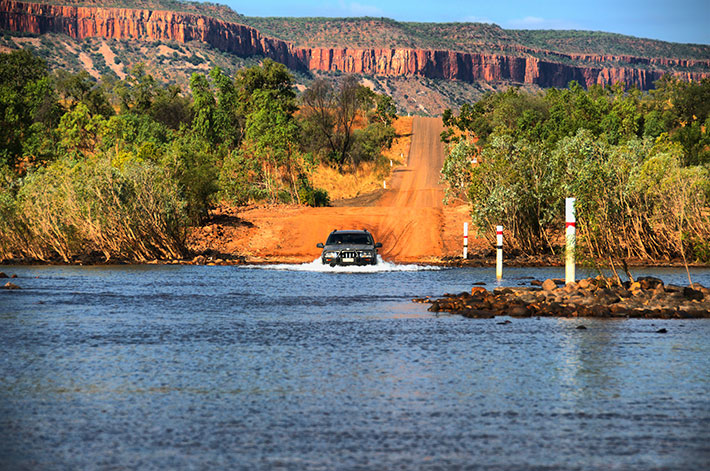
The whole adventure was very much walk to a gorge, get in the gorge, walk to another gorge, get in that one too. Which was great, because if the Gentleman and I had been driving the road alone, I don’t know we’d have committed in quite the same way. Despite the children running around with pool noodles stuffed into their rucksacks and really making a go of it. After dutifully getting in Tunnel Creek, Bell’s Gorge, Manning Gorge and the waterlilies of Galvan’s Gorge we headed off to El Questro Station across the Pentecost River.

El Questro had been talked up a fair old bit by old Greg, camp guitarist, singer, American accent talker and teller of tall tales. After five nights of sleeping in the bush, this camp site had a bar, he said. Steady on, I insisted, after all, we have campsites with bars in them even in Grimsby. (For those that don’t know, this is a thoroughly uninspiring north-east corner of the UK.) And we were packing a hell of a lot of juice – the Gentleman and I had not expected it to be quite the booze cruise it turned out, but Damo is there to be our guide and make sure we have a good holiday, and when it’s dark and the activities are done, what else is there to do but sit round the fire, drink beers and sing? A bar would at least ease the pressure on the icebox, furtively betraying us beneath our seats in the giant 4-wheel drive van by piercing our unopened cans with the combo of sharp ice and rough roads. The bar delivered (until we drank it dry), and as El Questro is an enormous cattle station, occasionally you’d see a cow wander around. These must be some of the most lean, free range organic beef cattle in the world, but who knows how many there are because there are no fences, and you have to get an external company in with helicopters and special gear to hunt down and round them up for selling. But here we were at the feet of the Cockburn Ranges (Australia pronounces all the letters, to my glee), the Pentecost River flowing by and the tall rocks heated up creeks to keep the Zebedee springs at a beautiful 38 degrees all morning. We were in them at 7am, lolling around in hot water between pandanus and ferns like a luxury tropical bathhouse. Apparently, they chuck all the proles out at midday and then the hot springs are the exclusive reserve of the posh lodges where celebrities are helicoptered in. They can keep it – who wants to be in hot water after midday? They’ve missed the best bit! True to that, we left Zebedee springs to hike to Emma Gorge; the coldest waterfall of the tour. Striding up the rocks we passed a limpid blue, sunlit and sparkling pool. Can’t we stop here, Damo? No. Get in the cold one. So we did and it was the true sublime; my breath was taken away by water kept in the shade all day by the enormous cliff surrounding it, the water was deep and murky, I swam towards the yawning black wall that was so tall as to block the great fiery sun and my soul expanded in the terror.

Right after I got out, someone shouted that they’d found a hot spring by the other wall. Bastard.

An Inheritance of Trees

I want to tell you about making friends. I have made some good ones in the past few weeks and knowing them has enriched life immeasurably. I implore you to meet them too.

On a charmingly sunny Saturday – bring out your favourite autumnal adjectives; it was crisp, it was clear, the sky was like a glass chalice – I dressed in green and brown (on purpose) and took myself up to City Hill. There were a few of us; some of us strangers, others profound friends, and we all braved the ankle twisting rabbit holes to assemble under the flagpole to meet our lead dryad of the trees; Sarah St Vincent Welch. She was to spend the next two and a half hours leading us through these trunks and branches for a poetry workshop as part of the Poetic City festival in Canberra.

Well let’s start with the setting. The workshop’s whimsical title was the same as this very review. Glorious! However, I wasn’t sure City Hill, garrotted by Vernon Circle from the rest of the city was what I had in mind when presented with such a dreamy nomination. Can’t we go to Haig Park? What about some grand old eucalypt on Ainslie, spreading limbs out like dancers to get the old similes going? No? That funny, oversized roundabout it is, then.

And thus arose the first in a long line of what seemed to me to be incongruous details that were in fact so meticulously and thoughtfully planned. To give an overview, every discussion, every shared piece of information, every picture was just so positioned so as to illuminate a unique perspective of our city that few people ever cross the spluttering traffic on Vernon Circle to actually see. It was a slow awakening, a dawning. Let me show you: our dryad poet begins, naturally, with introductions. It’s nice to create a safe space, make some connections. We all had to share a tree memory – very apt, and there were some crackers, from the poignant to the raucous. We also had to say something about our names. This left me a little dazed – I couldn’t work out how that was pertinent to trees. But hey-ho, it’s making connections, isn’t it? and, goodness, we have two and a half hours to fill, so that’ll do! Then Sarah began her gentle lecture which was more of a dream of story-telling; about Cypress, beloved of Apollo who killed a graceful deer and so bitter was his grief that he wept and begged to weep his regret forever until Apollo turned him into one of these; a Roman Cypress. They weep sap. Then through the metamorphosis of classical mythology, more names insinuated in through the mists of tellings; Monterey Pines, and I am lost in Kerouac’s Big Sur driving up and down the coast to Monterey, Pinus Radiata offers its image of children spinning in floating skirts with arms flung wide. The black locust tree. Do with that what you will.

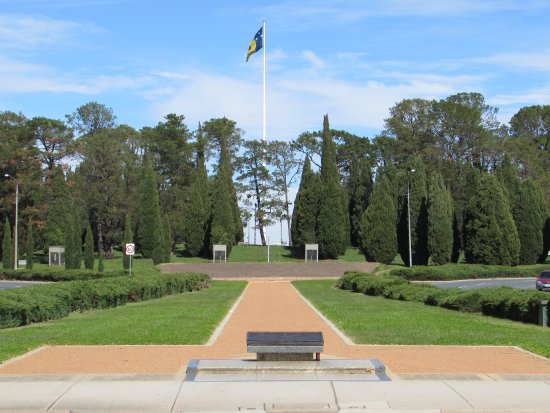
So that was names. Into the poetry samovar they went and bubbled away in our unconscious. Then came the history, who planted them, and why, good ol’ Walter and Marion’s visions. We were led up and around the hill and shown how the trees (and unbelievably, I never actually knew this) are planted in six crossing avenues. Through the centre of that hill – that roundabout – cross every geometric line drawn out on the Griffin-Mahoney plan. One view draws you along Commonwealth Avenue all the way to Parliament with the blue hills floating beyond, another revealed diminishing Northbourne, another; Constitution Avenue, lost in trees, next Mount Ainslie’s reassuring hump. Huh! Who knew? I had always thought City Hill was clustered randomly with these bizarre, pointed trees; odd, constrained growths. In fact, those trees form corridors like a Hellenic temple, their green Doric columns guiding the eye to visual revelations.

Into the pot that went. Along with warnings to not stick your face in a pine or a possum might have it off, with cockatoos eating Monterey pine seeds, associations of ceremony, memories of the red and yellow boxgums that would have stood there and the tension between native and European, a dry, hardy Mediterranean that flourished with Roman myths, long graveyard shadows, the desperate crying of ravens and stillness ruffled by flitting wagtails.

And then we were sent off. Off, off with you all, you have fifty minutes, here is a sheet of prompts, now go and stand in front of a tree, or sit on a bench in the sunshine, swivel in the centre like a compass between the views and write. And we did. I wrote a heap of nonsense, poet-t(r)ea (can I get away with that?) takes a while to brew, but we had a warm and beautiful final hour sharing touching thoughts and memories and words which the ravens had no respect for and wailed over. Magpie larks came to see what the fuss was about, and seeing that it was Anzac biscuits, hung around for a bit. With many COVID-safe hugs, we reluctantly skidded down the hill slopes, in six different directions, to our cars, our homes…the nearest public convenience.

But the strangest and most wonderful part of this workshop was the effect, the afterwards. For the next fortnight as I made my way through town, those pines peeped over the Sydney building, leaned round the courthouse and I am left with a strange and distinct feeling we are trying to catch sight of each other. And now a new part of the city is alive to me, is magical, somehow, is known, is recognised. It raises its green arms over the bridge, and waves – I lean over my balcony wall and wave back. It is a lovely, affectionate feeling that comes from quiet, from listening with patience, from watching and engaging all your thoughts to strive for the exact metaphor to describe this thing. I now regularly tramp across its green and brown slopes (research completed so you don’t have to: it’s less fun in the rain) and I have that same physical feeling of enrapturement that I feel when I behold huge mountains, or the sea. I am poetic in tendency, so these extremes must be forgiven. But I carry these pines now in me as I walk through town, and in the corner of my eyes, and feel the strange power of those ley lines. They have created in me since many more poems that I actually like, quite a lot. And I feel as if I have been given a marvellous gift, wrapped up in everlasting green and lit with Roman candles that nothing can ever take away.

Manson Muck-Up

Like a lot of 90s kids who got in to got into Nirvana a bit late then had to practically go through the death of Cobain twice and have by now donated the most intensively Goth section of our wardrobes to the next generation as we’ve stopped going to metal clubs and in betrayal to our younger selves, no longer see ‘Wednesday’ as sufficient reason to just wear a corset… I’ve been feeling pretty let down by these recent allegations about Marilyn Manson. And I need to talk about it. I need to reach out to people who were/are fans and try and work out where we are now and where we can go from this.

I think I’m most upset because I didn’t see it coming, but I when I heard, I felt I really should have. This is conflicting. I’ve read his autobiography, I’ve listened to all his early albums cross legged on my bed, following along with the sleeve lyrics (old school be cool), I read interviews in Kerrang! and other music magazines. I knew all about what he thought, how he treated people, his weird sexual deviances influenced by his very creepy sounding (probably in need of help?) grandfather and his attitude to rebellion. And I lapped it up. All that stuff I’m wincing at now, I thought was amazing at the time. Was I totally taken in?

My saving grace is a vague sense that as a teenager (despite being appalled after my mum read his book and handed it back with a glazed smile saying ‘prick’), I’m sure I had the sense that, like, ‘hur hur, he’s amazing and crazy, but I wouldn’t wanna go out with him!!’ I used to fantasise about being Reznor’s girlfriend, and, yes, saving him, -_- but I don’t think I fancied Manson in the same way. I hope. And after all, a crazy rock star turning out to be a bit of a knob to go out with is nothing staggeringly unexpected. But he was appealing; dangerous, sexy, articulate, and intelligent. As a goth being different from the mainstream, to all of us that didn’t want to follow the bubblegum blandness of boy bands and unstimulating manufactured muzak, he was a saviour. For those of us that wanted to look different from the massive, hooped earrings, too much makeup and tracksuits girls, he showed us we could be brave enough. For our generation (and ours is not special, every generation looks to rebel against something in the one before), he showed us the emptiness of consumerism, the folly of shallow celebrity created by an obsessive media and the hypocrisies and lies in authorities that want us to shut up, be the same and not question. He showed us an intensity of feeling that 5ive just couldn’t match, he had a message, he was anti the church, and as a Catholic schoolgirl asking why my teachers stopped talking when we asked certain questions, I was all over that. Now in Australia, I can sit at a table of eight peers and seven of them who went to religious schools (and they seem to be The Thing in Australia) will have heard at least one rumour about all the typical Catholic shit going down in their own school. And Manson called that out. He was a Fuck You and a deeper thinker and a snappy dresser. Of course we adored him.

And part of that, I stand by. I’ve been pissed off hearing comments like ‘I always knew,’ or ‘I never trusted him,’ or ‘yeah, he looked like a weirdo,’ because unless they were fans, they have no right. I don’t wanna go all ‘Nam, but ‘you don’t know, man, you weren’t there.’ Yeah, the dude looked weird, no denying it, but that was the whole point; he challenged convention and was against judging by appearance, which is all those comments reveal, and is an insult to the adult generation of mourning Manson fans. Because not all assholes helpfully give you prior warning by looking crazy. Grame Tame’s abuser just looked like the secondary teacher he was. (Northern Hemisphere-ers, have a quick google of this Australian of the Year.)

So how many other old Manson fans my age are looking at this crap, remembering the interviews, the book, the lyrics, the drama, and are thinking…shoulda seen this coming? Because, looking back, while I personally found some songs a bit stupid (never a huge fan of Dope Show), many were great, but I am forced to admit that while he challenged society, he wasn’t offering a solid alternative. I can’t say he was some peace preaching hippy calling for power redistribution and the protection of minority groups; that was never the jam. And though I found ‘Last Day On Earth’ romantic and beautiful, Manson didn’t always write beautiful things. For all the charm and articulate arguments that follow like insidious intent, there was always a huge lack of empathy in how he treated fans. The people he didn’t need anything from. That was all there in front of us, in his interviews and books and we accepted it. And that’s scary. My first thoughts were shame; what the hell else would I accept and permit from someone that I admired; that stood for something I believed in? Reading about his fantasies of violence against women, his actual attack on his own mother and a whole bunch of stuff that was clearly consensually dubious, why did I overlook it or accept it? Why did I permit it, or even sometimes think, ‘well, we know what Manson’s like, don’t get drunk with him!’ All for a person who is charming, articulate, powerful and exciting – am I describing a textbook psychopath now?

So how do we get taken in? Where’s the line between being a psychopath and just being a bit of a dick to go out with? Are we more permissive when we’re young? Is that natural or inexcusable? When I was in my early twenties, I had a deep and intense relationship with a guy that I thought was the most important thing in the world. He’d been making his case for two years and I’d never felt so necessary and wonderful. Maybe we need to go through shit like that before we can really understand that it’s not healthy. Then when I moved to abroad for six months, as discussed and planned for the whole previous year (while living with him, I moved in to save up for the trip), the chap was pretty horrible. Every phone call was about how selfish and cruel I was, how naïve and ignorant to let these people exploit me, how I needed to give up on what I was doing (learning a language for a fixed period of time which was important to me and had been my plan for years before I knew him) and come home and be with him. Now look, I’ve never thought I was in an abusive relationship or experiencing coercive control. I think the guy was just a bit of a selfish dick at the time. He needed to do some growing and learning about how to love just as much as I did. And I’m sure he has grown and moved on from that sort of thing. But the line there is thin. I was resilient enough to feel that he couldn’t be right, but when he made his arguments, they were logical, and I did agree although my heart didn’t. Young people want to feel loved and important and intensity and drama in relationships at that age, with your Manson soundtracks crooning ‘I’m so empty here without you, I crack my xerox hands’ seem so deep and profound. But we all look back and realise it’s not. Because, hey kids, if you’re in it to ‘save him’ it’s never gonna work.

So it’s scary that I lapped up Manson’s crap and it’s borderline scary I accepted a relationship that for six months made me feel like shit, but perhaps we can be forgiven for some of those things. Because I was young, I had stuff to learn, and I learned it. It’s all not as scary as the permissiveness in the culture. How years ago, we learned Twiggy Ramirez abused and raped his girlfriend Jessika Addams of Jack Off Jill, that James Maynard Keenan would enjoy his teenage fans and even Trent Reznor is implicated. I can’t quite let go of him, but even though he insists he did nothing abusive, being off your tits on coke while horrible shit’s going down next to you doesn’t exactly leave you blameless. Why did no one challenge these things? Why did journalists giggle along instead of call the police? Why did none of the maaaaaaany people my ex spent many a night convincing I was Europe’s biggest bitch not delicately suggest he should take a deep breath, stop giving me hell and maybe taking a little trip abroad to visit me might make us both feel better?

I know the ultra-liberals, like the academics before will tell me to appreciate the music and condemn the man; separate the art from the artist. I have never been able to suck this up. Can we afford to? Can we say of racist Conrad that his book is just ‘of its time’ as if that condones it? And we are back to permitting. I suppose I need to have a word with myself about Shelley, then. Full blown nutter – turned up at sixteen-year-old (don’t forget that, everyone, sixteen) Mary’s house in the middle of the night with a gun, saying he would shoot himself unless she ran away with him then and there. Carried on with her stepsister for a couple of years, told them both they were in a loving relationship of three. Bullshit was a seventeen-year-old down with that; she was impressed by the mad and intense attentions of a handsome, intelligent, and passionate poet and got talked into it. Groomed. But Shelley’s work really was beautiful. And there was empathy and there were calls for social justice, not just rebellion for its own sake. Madness yes, perhaps not psychopathy.

Ultimately, after the guilt and the disappointment, I feel betrayed. Because, Manson, you sang out against shallow society, against hypocritical power structures, against shallow media frenzies and you stood for the outsider. Us misfits who tried to think, not just consume, and you gave us something to think about. I never thought you were God, or the Answer, but you were a way to think differently, and take the bits you agreed with. Then you let us all down by being the one after all who was a hypocrite, a sleaze. In your ‘rape rooms,’ your after parties and your relationships, you made outsiders and you did all the things we screamed against. You betrayed what you stood for in favour of mad power, and you betrayed us. Fuck you, man.

So for me, it’s time to give Mechanical Animals one last hurrah, hen sadly shake my head and turn away. I’m gonna stick to Rage Against the Machine. Clearer message, better empathy. And more catchy.